Complete Guide to Profile Light Channel Sizes & Aluminum Profiles
Nowadays, everyone is installing LED lights, even though they are truly suitable for only specific areas—such as small halls or rooms. However, installing exposed LED strips reveals the wiring, the visible light dots can be harsh on the eyes, and the strips tend to overheat and fail prematurely. To avoid these issues, one should use aluminum profiles.
Using the right profile light channel not only keeps your LED strips secure but also ensures the light beam looks smooth and professional. In this article, we will guide you on understanding profile light sizes, channel types, and how to select the right profile.
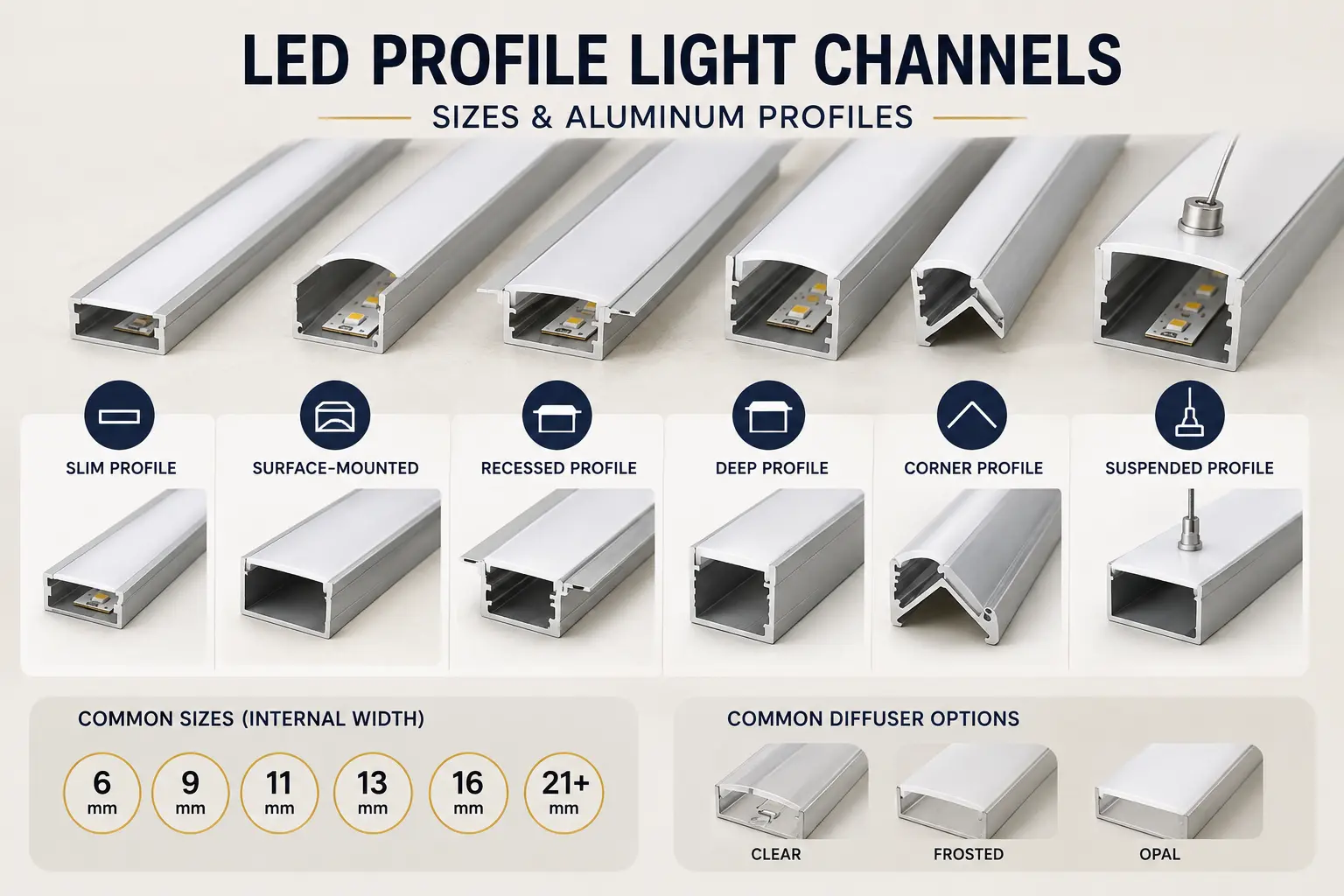
What is a profile light channel, and Why Do You Need It ?
A profile light channel (also known as an LED aluminum casing) is an aluminum frame designed to house LED strip lights. It is fitted with a frosted plastic cover (diffuser) that transforms the individual LED dots into a smooth, continuous line of light.
Key Benefits of Aluminum Profiles :
Heat Dissipation: High-brightness LED strips generate heat; the aluminum profile acts as a heat sink, helping to extend the lifespan of the LEDs.
Protection Against Dust and Damage: It shields the LED strip from dust, moisture, and physical damage.
Clean & Premium Look: Instead of harsh lighting, it provides a uniform, premium architectural glow.
| Requirement | Suggested Profile |
|---|---|
| Small cabinet lighting | 8–12 mm internal channel |
| Standard LED strip | 12–15 mm internal channel |
| 12 mm LED strip | 13–16 mm internal channel |
| High-output strip | Wide/deep aluminum profile |
| Dot-free appearance | Deep profile + frosted/opal diffuser |
| False ceiling | Recessed profile |
| Modern office | Suspended or wide profile |
| Furniture edge | Slim profile |
| 90° corner | V-shaped/corner profile |
| LED Strip Width | Recommended Internal Channel Width | Common Application |
|---|---|---|
| 5 mm | 6–7 mm | Compact decorative lighting |
| 8 mm | 9–10 mm | Cabinets and furniture |
| 10 mm | 11–12 mm | Standard profile lighting |
| 12 mm | 13–14 mm | Ceiling and architectural lighting |
| 15 mm | 16–17 mm | High-output LED strips |
| 20 mm+ | 21 mm+ | Wide or high-power lighting |
A small amount of clearance makes installation easier and prevents the LED strip from being compressed or damaged.
| Profile Type | Standard Width (mm) | Standard Depth (mm) | Best Application Use Case |
|---|---|---|---|
| Slim / Mini Profile | 10 mm – 12 mm | 6 mm – 8 mm | Thin furniture grooves, kitchen cabinets |
| Standard Recessed Profile | 17 mm – 20 mm | 10 mm – 15 mm | False ceiling, drywall, wall grooves |
| Deep Profile Light Channel | 24 mm – 35 mm | 20 mm – 35 mm | Seamless dotless lighting, main lighting |
| Corner Profile Light | 16 mm x 16 mm | 45-degree angle | Cabinet corners, wardrobe edges, wall junctions |
Can Aluminium Profile Lights Be Used in Walls and Ceilings?
Yes, aluminium profile lights can be used on both walls and ceilings. They are widely used in the interiors of homes, offices, hotels, showrooms, and commercial spaces today because they provide a clean, seamless linear lighting look.
For ceilings, these profiles can be installed in false ceilings, gypsum ceilings, POP designs, and wooden panels. They can be used to create straight lines, borders, or geometric patterns, or to highlight specific areas of a room. On walls, they are excellent for accentuating decorative panels, niches, TV units, headboards, and architectural features.
Where Can Aluminium Profile Lights Be Used?
| Installation Area | How It Is Used | Recommended Profile |
|---|---|---|
| False Ceiling | Creates modern linear or decorative lighting | Recessed Profile |
| Gypsum Ceiling | Gives a seamless built-in lighting effect | Trimless or Recessed Profile |
| POP Ceiling | Used for borders, patterns, and ambient lighting | Recessed Profile |
| Living Room Wall | Highlights wall designs or decorative panels | Recessed or Surface-Mounted |
| Bedroom Wall | Used behind headboards or wall panels | Recessed Profile |
| TV Unit | Creates soft backlighting and highlights the design | Surface or Recessed Profile |
| Wall Corners | Provides indirect or directional lighting | Corner Profile |
| Wooden Panels | Adds decorative linear lighting | Slim Recessed Profile |
| Office Interiors | Used for functional and modern linear lighting | Suspended or Recessed Profile |
Choosing the Right Profile
The type of aluminium profile depends on how and where you plan to install it:
| Profile Type | Best For | Main Benefit |
|---|---|---|
| Recessed Profile | Walls and false ceilings | Clean, seamless appearance |
| Surface-Mounted Profile | Existing walls and ceilings | Easy installation |
| Trimless Profile | Premium interiors | Creates a smooth, borderless finish |
| Corner Profile | Wall and ceiling corners | Directs light at an angle |
| Deep Profile | High-brightness LED strips | Helps create smoother light diffusion |
When selecting a profile, it is also important to consider the LED strip's width, wattage, profile depth, diffuser type, and the available installation space. Using a deep aluminum profile paired with a high-quality diffuser can minimize visible LED dots and create a uniform line of light.
In short, aluminum profile lights are an excellent choice for both walls and ceilings. Whether you desire subtle ambient lighting or a striking architectural lighting design, choosing the right profile can give the space a modern and professional look.
How can you purchase aluminium profile lights in bulk from Mayo World?
Let’s understand the process in a few steps:
1) First, visit the official Mayo World B2B Marketplace to explore the available products:
Mayo World offers a wide range of products. If you are looking for information or wish to purchase aluminium profiles, simply type "aluminium profile" into the search box. You will see several suggestions; select the option that best matches your requirements.
2) Once you are on the product page, you will see two options for making a purchase: WhatsApp and "Send Inquiry." You can choose either option to purchase directly from the dealer in bulk.
Final Thoughts
Selecting the right profile light channel size involves more than just considering external width or aesthetics. The most critical factors are:
- LED strip width
- Internal channel size
- Profile depth
- LED wattage
- Heat dissipation requirements
- Diffuser type
- Installation method
For general applications, always measure the LED strip first and choose an aluminum profile that offers sufficient internal space for easy installation. For high-power or architectural lighting, opt for a wider or deeper profile that can effectively manage heat and deliver a clean, uniform line of light.
By pairing the right LED strip with the appropriate aluminum profile, you can achieve superior installation quality, better heat management, extended LED lifespan, and a professional-looking lighting finish.
Frequently Asked Questions (FAQ)
1. What is an LED profile light channel?
An LED profile light channel is an aluminum housing designed to hold and protect LED strip lights while providing better heat dissipation and a clean finish.
2. What size aluminum profile is suitable for a 10 mm LED strip?
For a 10 mm LED strip, choose an aluminum profile with an internal channel width of at least 11–12 mm for comfortable installation.
3. Which aluminum profile is best for false ceilings?
Recessed or deep aluminum profiles are commonly used for false ceilings because they create a clean and seamless linear lighting effect.
4. What is the difference between surface-mounted and recessed LED profiles?
Surface-mounted profiles are installed directly onto a surface, while recessed profiles are fitted inside a groove or cut-out for a flush appearance.
5. Why is aluminum used for LED strip profiles?
Aluminum helps dissipate heat generated by LED strips, provides structural support, and improves the overall appearance of the lighting installation.
6. What profile depth is best for a dot-free lighting effect?
A deeper aluminum profile combined with a frosted or opal diffuser generally helps reduce visible LED dots and creates smoother lighting.
7. Can a 12 mm LED strip fit inside every aluminum profile?
No. Always check the internal channel width. A 12 mm LED strip should ideally be used with a profile that has at least 13–14 mm of internal space.
8. What are the common lengths of aluminum LED profiles?
Aluminum LED profiles are commonly available in 1 metre, 2 metres, 2.5 metres, and 3 metres lengths, depending on the supplier.
9. Which diffuser is best for LED aluminum profiles?
Frosted or opal diffusers are generally preferred for smoother and more uniform lighting, while clear diffusers provide higher brightness.
10. Can LED aluminum profiles be used in wardrobes and cabinets?
Yes. Slim surface-mounted or recessed aluminum profiles are commonly used for wardrobes, kitchen cabinets, shelves, and furniture lighting.
11. Which profile is suitable for corner lighting?
A V-shaped or corner aluminum profile is suitable for 90-degree corners, furniture edges, under-cabinet lighting, and wall corners.
12. How do I choose the right LED aluminum profile?
Consider the LED strip width, wattage, profile depth, installation location, heat dissipation requirements, and the type of diffuser needed before selecting a profile.