Complete Guide to Profile Light Channels: Surface vs Recessed vs Hanging
In contemporary interior design, one of the basic principle is to choose the right profile light channel for smooth dot-free linear lighting. Aluminum channels safeguard fragile LED strips from dust, assist in heat management, and grant a neat and smart architectural finish to false ceilings, walls or furniture.
Key Takeaways
Main features: Thermal heat sink, LED strips protection from dust, Light Diffusion of harsh dots.
Mounting Types: Surface-Mounted (for retrofitting), Recessed (flush with ceiling finish) and Hanging (suspended fixtures).
Raw materials | The extruded 6063-T5 aluminum has the maximum heat Dissipation efficiency for a long run LED light.
Main Functions of a Channel for Aluminum Profile
Here are three important technical functions that aluminum profile light channels perform in any commercial or residential lighting design :
Thermal Management: High-grade aluminum dissipates operational heat away from LED strips, preventing premature chip burnout.
Diffused light: Using frosted or opal Polycarbonate covers ensures a continuous and dotless line of linear lighting.
Guard: Protects soft LED stripes from dust, moisture and accidental mechanical damage.
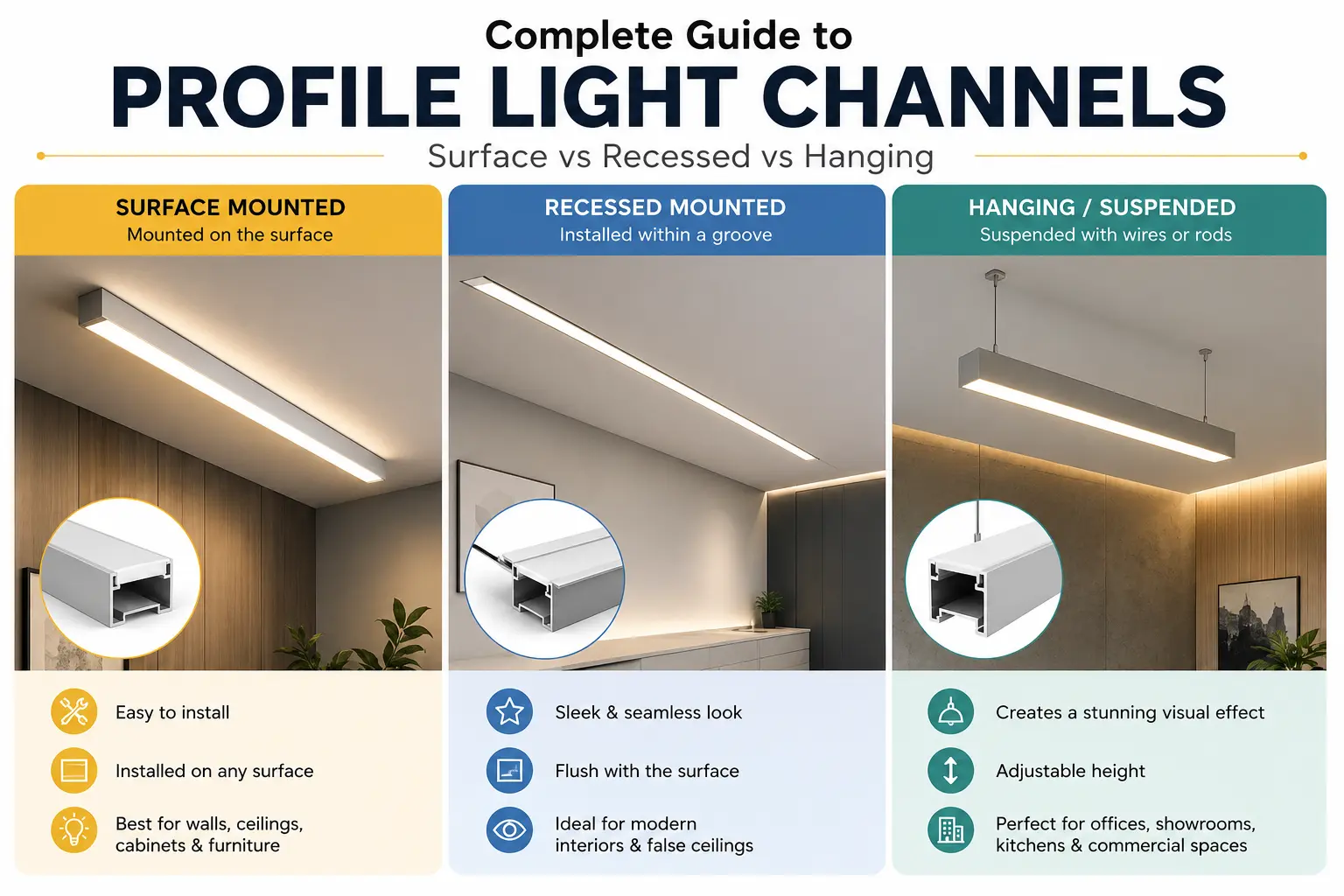
Types of Profile Light Channels: Comparison Table
Selecting the right profile light channel depends on ceiling depth, installation method, and aesthetic requirements.
| Profile Type | Mounting Method | Ideal Application | Installation Complexity |
|---|---|---|---|
| Surface Profile Light Channel | Direct surface screw/clip mounting | Concrete ceilings, under-cabinet lighting, wardrobe shelves | Low (No wall cutting required) |
| Recessed Profile Light Channel | Embedded flush inside pre-cut grooves | POP false ceilings, gypsum walls, custom furniture | Medium to High (Requires flange slotting) |
| Hanging / Suspended Channel | Suspended via steel wire kits | High-ceiling offices, reception areas, dining tables | Medium (Requires suspension alignment) |
If you require accurate dimensions and details of internal channel clearance for specific strip widths, see our profile light channel sizes guide.
Material Specifications: Anodized vs Powder-Coated Channels
| Feature | Anodized Aluminum Channel | Powder-Coated Channel (Black/White) |
|---|---|---|
| Best For | Maximum heat dissipation & structural durability | Decorative accent walls & exposed dark ceilings |
| Corrosion Resistance | Extremely high (ideal for high-humidity areas) | High (scratch-resistant finish) |
| Thermal Efficiency | Direct metal-to-air heat release | Slightly insulated by coating layer |
How to Calculate Channel Depth for Dotless Lighting
To eliminate visible LED spots, follow the Dotless Ratio Rule:
Formula: Channel Depth = Chip Spacing × 0.5 to 0.8
Example: If your LED strip has a chip spacing of 10 mm, choose an aluminum profile channel with a minimum depth of 5 mm to 8 mm along with an opal diffuser cover to guarantee a completely uniform, dot-free continuous light line.
Choose the Best Profile Light Channel for Your Space
-
Match the Channel Width to LED Strip Size
Be careful that the internal channel width is at least 1 mm to 2 mm larger than the LED strip width. 1" strips equal or slightly smaller than 10 mm strips will fit into channels with internal opening of about 11–12 mm wide.
-
Choose the Right Diffuser Type
- Opal/Milky Diffuser — Full visible dot blocking; perfect for clean architectural lighting
- Frosted Diffuser: Provides a mix between dots reduction and high light output.
- Clear Lens – Delivers maximum light output, ideal for indirect or hidden cove lighting.
-
Consider Heat Sink Capacity
If a LED strip is operated over 14W per metre, make sure a thick-walled aluminum profile channel is used for sufficient heat sink capacity.
Explore Mayo World’s commercial-grade heavy-duty aluminum channels designed for maximum heat dissipation.
Troubleshooting Common Profile Light Channel Issues
Issue: Visible LED Dots (Spotting)
Reason: Too shallow channel depth + Low-density LED strips (<60 LEDs/m)
Solution: Implement a profile channel with a depth of at least 15 mm, along with an Opal diffuser or COB (Chip-on-Board) LED strip.
Channel warping or light leakage issue
Problem: Low grade alloy aluminum used or end caps / mounting clips not included.
Solution: Always specify 6063-T5 Anodized Extruded Aluminum channels and always install end caps with silicone gaskets for neat edge seals.
Pre-Purchase Profile Channel Checklist
[ ] Width Clearence: Internal width is minimum 1.5 mm wider than the LED PCB strip.
[ ] Power Load: Total Wattage/metre supported, within the overheating threshold of the profile density.
[ ] Mounting Accessories: Consist of mounting clips, 45 degree corner connectors and end-caps.
[ ] Diffuser Transmission: Filled with the efficiency preference of putting brightness over aesthetics or dot-free performance.
Looking for Bulk Aluminum Profile Channels for Your Project?
At Mayo World, we supply premium 6063-T5 Extruded Aluminum Profiles with custom diffusers, end caps, and mounting accessories for architects, interior designers, and lighting contractors.
Browse Mayo World’s Profile Light Channel Collection & Get Wholesale Quotes
Why Source Profile Channels from Mayo World
Whether you are looking for surface, recessed or suspended linear lighting solutions, Mayo World can provide the finest profile channels designed for residential and commercial lighting projects.
Specification: Solid, High-grade 6063-T5 aluminum for excellent heat sink efficiency.
Included Accessories: end-caps, mounting clips and 45 degree connectors.
Wholesale B2B Pricing: Factory-direct pricing for contractors, interior designers, and retailers.
Frequently Asked Questions
Q: What is the standard length of an aluminum profile light channel?
A: Standard aluminum profile light channels are typically supplied in lengths of 2 metres (approx. 6.5 feet) and 3 metres. They can easily be custom-cut using a standard fine-toothed hacksaw or miter saw to fit specific wall or ceiling dimensions.
Q: Can I use profile light channels outdoors or in bathrooms?
A: Yes, but you must select an IP65 or IP67 weather-rated profile light channel equipped with silicone-sealed end caps, waterproof diffusers, and an IP65 outdoor LED strip to prevent moisture ingress.
Q: How do you fix an aluminum profile light channel to a surface?
A: Surface-mounted profile channels are fixed using metal mounting clips screwed directly into the surface, double-sided high-tack mounting tape for light-duty cabinet applications, or direct countersunk screws through the aluminum base.
Q: What is the difference between COB LED strips and profile channels for dotless light?
A: COB (Chip-on-Board) LED strips have ultra-dense LED packing that creates a dotless beam even in shallow profile channels. Traditional SMD LED strips require a deeper profile channel (minimum 12–15 mm depth) with an opal diffuser to eliminate visible light dots.
Q: Do profile light channels reduce the brightness of LED strips?
A: Yes, diffuser covers slightly reduce light output depending on their opacity. An opal/milky diffuser reduces brightness by approximately 20% to 30% to deliver a smooth dotless effect, while clear diffusers lose less than 5% of total lumen output.