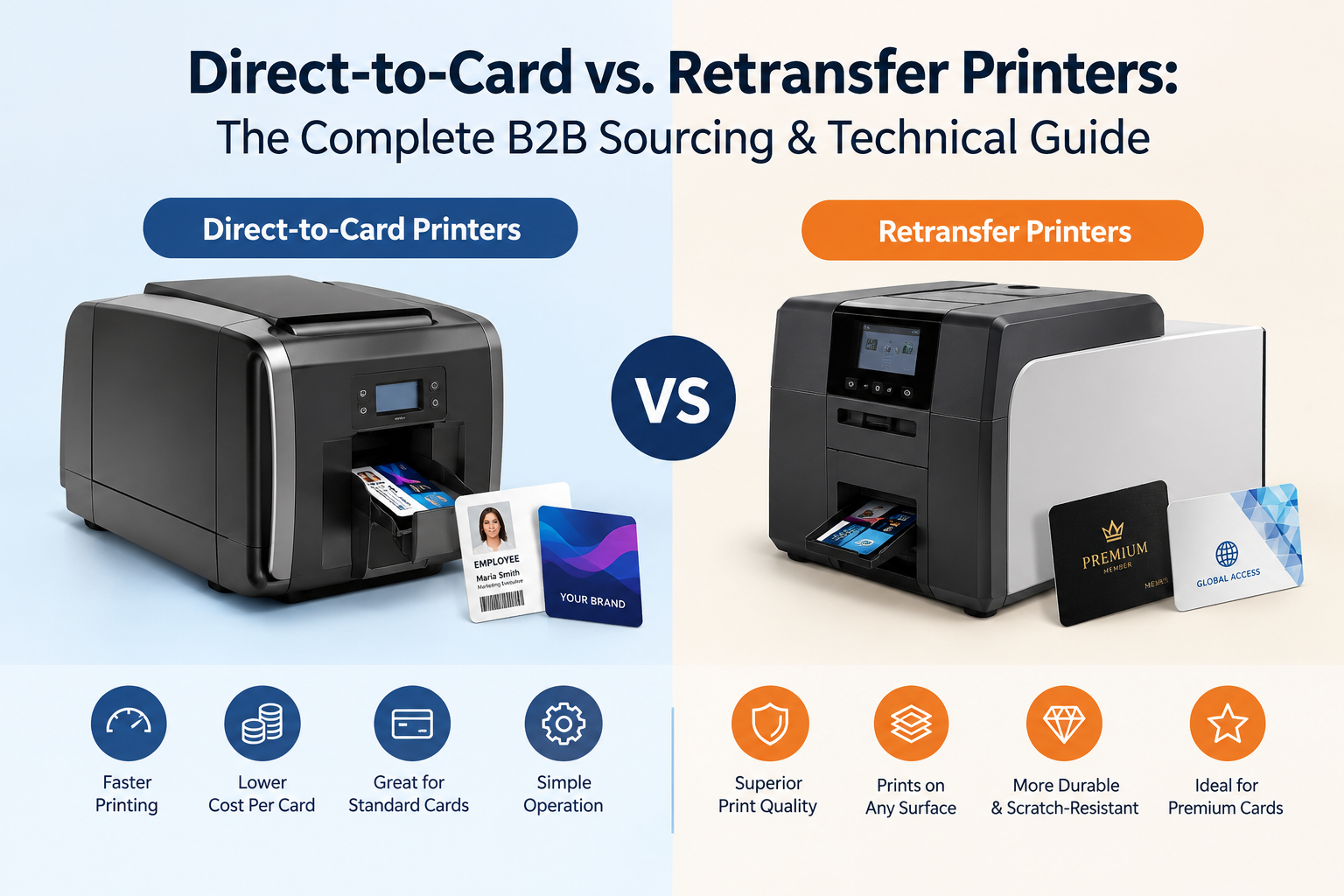
Selecting an appropriate identification card printer is an important infrastructure decision to make for corporate IT departments, schools, government agencies, and hospitals. Industrial card printer machines are used to encode high-resolution images, employee photo ID, barcodes, and microchip data on plastic PVC, ABS, Polycarbonate, or PET cards.
When buying such equipment in bulk, B2B purchasers should be aware of two printing technologies used in the card production: Direct-to-Card (DTC) and Reverse Transfer (Retransfer).
The current paragraph will discuss the technical intricacies of both processes, cost projections, maintenance practices, and sourcing advice for enterprises considering buying such equipment.
1. Core Printing Technology Breakdown
A. Direct-to-Card (DTC) Dye-Sublimation
With a Direct-to-Card method, a thermal print head makes direct contact with the surface of the plastic card. Microscopic heating pins within the print head heat up a multi-panel dye ribbon (YMCKO) and allow the ink to sublimate directly onto the porous PVC substrate layer. Print Coverage: Leaves a small, white unprinted border (0.1 mm) around the card edge that is referred to as an Edge-to-Edge printing. Best Suited For: High-volume standard student ID cards, visitor passes, and membership badges on a flat, non-chipped PVC card.
B. Reverse Transfer (Retransfer) Technology
Retransfer technology utilizes a two-step printing method. In the first step, the card design gets printed in the reverse manner on a thin transparent intermediate transfer film roll. In the second step, the transferred image gets bonded to the surface of the plastic card under heat and pressure. Print Coverage: Covers the entire card surface without any white border, also referred to as Over-the-Edge (full bleed) coverage. Best Suited For: Proximity cards, smart cards with uneven internal microchips/antennas, government national IDs, and financial card personalization.
2. Technical Comparison Matrix
Operational Parameter | Direct-to-Card (DTC) Printers | Retransfer (Reverse Transfer) Printers |
|---|---|---|
Print Head Contact | Direct contact with card surface | No direct contact with card surface |
Print Coverage | Edge-to-Edge (Leaves white border) | Over-the-Edge (True full bleed) |
Print Resolution | Standard 300 DPI | High-Definition 300 DPI to 600 DPI |
Smart Card Compatibility | Risk of print head damage over microchips | 100% Safe for uneven smart cards |
Substrate Compatibility | Standard Glossy PVC & Composite PVC | PVC, PET, ABS, Polycarbonate, Smart Cards |
Print Head Lifespan | Sensitive to dust scratches and card edges | High durability (Protected by film layer) |
Average Hardware Cost | Economical to Mid-Range (₹35,000 – ₹95,000) | Enterprise Grade (₹1,20,000 – ₹2,50,000+) |
3. How to Calculate Per-Card Printing Costs
To manage recurring operational expenses, procurement teams evaluate the total cost per card using ribbon yield formulas:

Example Cost Breakdown (Single-Sided Color Print):
- YMCKO Ribbon Roll: A 2,200 ribbon yielding 200 prints would be 2,200/200 = 11.00/per print.
- Blank CR80 PVC Card: High gloss white printable PVC card = 3.00/per card
- Cleaning kit/wear allocation: Isopropyl swab maintenance; 0.50/per card.
- Estimated total cost would be 14.50/per printed single sided card.
4. Protective Measures for Printer Heads
Proper maintenance prevents thermal print head element burnout and line blemishes on output cards:
Conduct periodic swabbing: After each ribbon change (every 250-500 prints), clean transport rollers with an isopropyl alcohol cleaning card.
Prevent particulate buildup: Store blank PVC card stock in a dust free, sealed environment. The accumulation of dust causes micro-scratches to develop on heating pins.
Use approved blank cards: Avoid using lower grade or damaged PVC cards which create print head abrasions and uneven ink coverage.
5. Sourcing via Verified Manufacturers & Suppliers
Working directly with established Indian B2B suppliers ensures access to genuine hardware, warranty support, technical repair services, and direct ex-factory rates. Verified vendors on Mayo World—including Thinkbotic Technology Private Limited and Jain Info Solution—supply industrial card printers, YMCKO color ribbons, smart card encoders, and printing consumables across India.
Sourcing Callout:
Looking to procure an industrial card printer machine or source printing consumables? Compare technical specifications, review wholesale price lists, and connect with verified suppliers directly on Mayo World's Card Printer Machine Category Page.