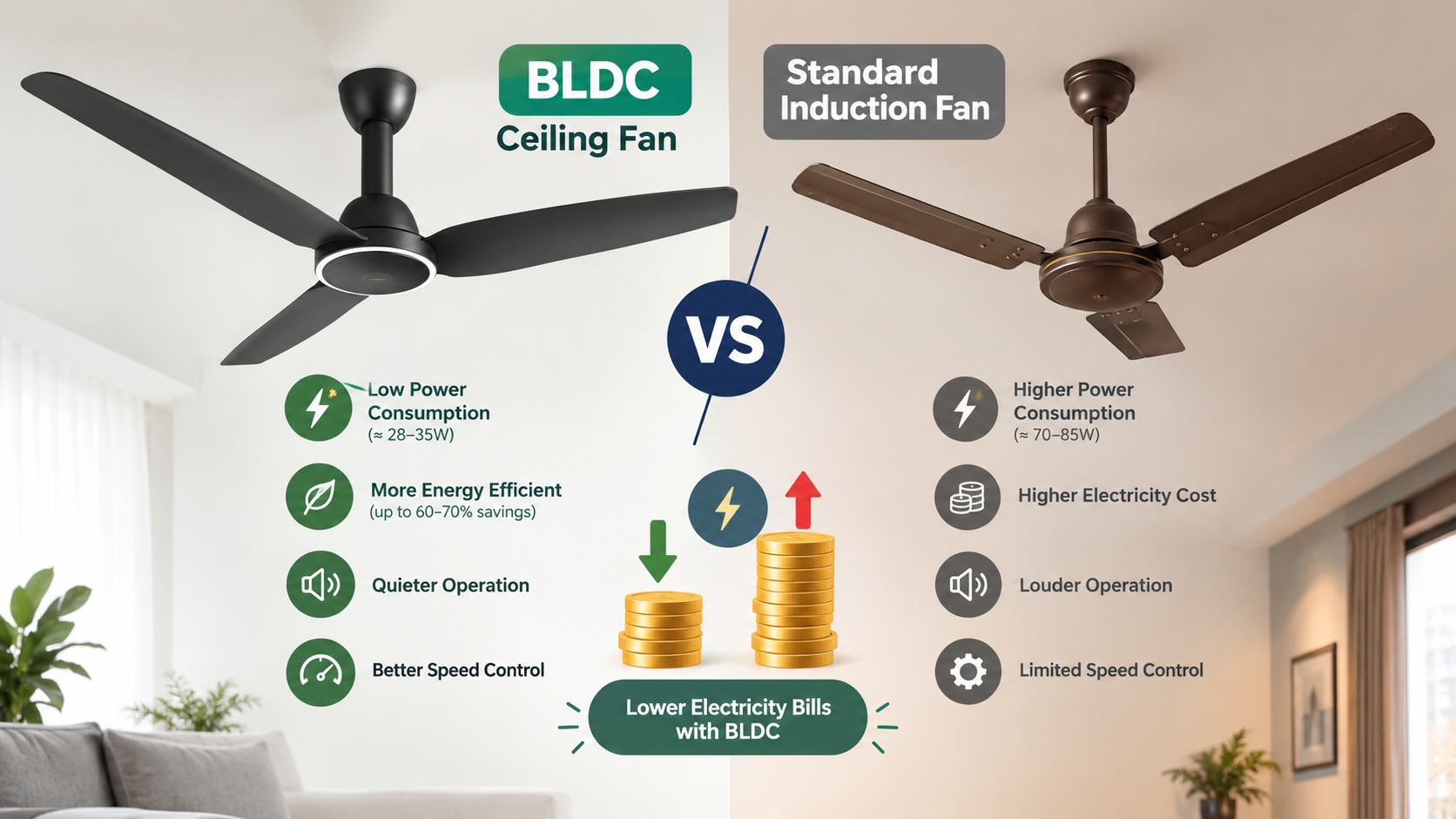
With increasing electricity rates in India, energy efficient appliances have become a necessity. The ceiling fan in your home, office and educational institution is running 12-18 hours a day and is one of the largest contributors to your monthly electricity bill.
The new bldc ceiling fan technology has changed the game when it comes to cooling your room. This new technology now uses brushless direct current motors instead of old AC induction motors, giving you an ultra efficient ceiling fan. This article compares bldc ceiling fans to traditional induction fans. We will look at how efficient they are, how much money they can save you over the year, how well they work with inverter back up and what their ROI looks like in the long term.
1. Power Consumption Comparison: BLDC vs Induction Fan
The fundamental difference between a standard induction fan and a bldc ceiling fan lies in their motor mechanism and energy conversion efficiency:
Traditional Induction Fan : Uses AC power, copper windings and a physical control. Lots of electricity is wasted as heat. Up to 75W-80W at full speed.
BLDC Ceiling Fan : Uses permanent Neodymium Magnets and an internal electronics SMPS to convert AC to DC. No loss due to friction. Only uses 26W-32W at full speed.
2. Electricity Bill & Annual Cost Savings Matrix
To understand the real financial benefit of installing a bldc ceiling fan, let us calculate the operating cost of running 1 fan for 14 hours daily at an average commercial/residential power tariff of ₹8 per kWh (Unit):
Parameter / Feature | Traditional Induction Fan | Modern BLDC Ceiling Fan |
|---|---|---|
Average Power Consumption | 75 Watts | 28 Watts |
Daily Running Hours | 14 Hours | 14 Hours |
Daily Energy Consumption (kWh) | 1.05 Units | 0.39 Units |
Monthly Energy Consumption | 31.5 Units | 11.7 Units |
Monthly Electricity Cost (@ ₹8/Unit) | ₹252 | ₹93.60 |
Annual Electricity Cost (Per Fan) | ₹3,024 | ₹1,123 |
Net Annual Savings Per Fan | — | ₹1,901 / Year |
Key Takeaway: Switching to a single bldc ceiling fan saves approximately ₹1,900 per year in electricity bills. For commercial facilities using 50 to 100 fans, annual savings can exceed ₹1,50,000 to ₹1,90,000.
3. Inverter Backup & Performance During Power Cuts
Power outages are common across many regions in India, making inverter efficiency a crucial purchasing factor:
3x Long Inverter Runtime – The bldc ceiling fan uses 65% less current from your inverter batteries meaning that it will run up to 3 times longer than a normal fan.
Super Quiet – Ordinary fans can be very annoying and noisy due to the humming they make when using the inverter square wave. The BLDC fan is completely silent without any heat or noise.
Constant RPM – Ordinary fans can have a big drop in speed when the voltage drops. Built in smart motor drivers mean the speeds of bldc ceiling fans are constant between a wide range of voltages (140V-285V).
4. Summary: Is Upgrading to a BLDC Ceiling Fan Worth It ?
Although the initial purchase price of bldc ceiling fans may be slightly more than conventional fans, they will pay for themselves within 12 to 18 months due to their energy efficiency. Business owners, electrical contractors and facilities managers will benefit by having increased energy efficiency, increased life span of the product and reduced costs in the long term by upgrading to use BLDC motors.
Looking to Source BLDC Ceiling Fans in Bulk ? Access direct factory-gate quotes, 5-star rated models, and wholesale pricing from verified suppliers on Mayo World's Wholesale BLDC Ceiling Fan Manufacturers Directory.