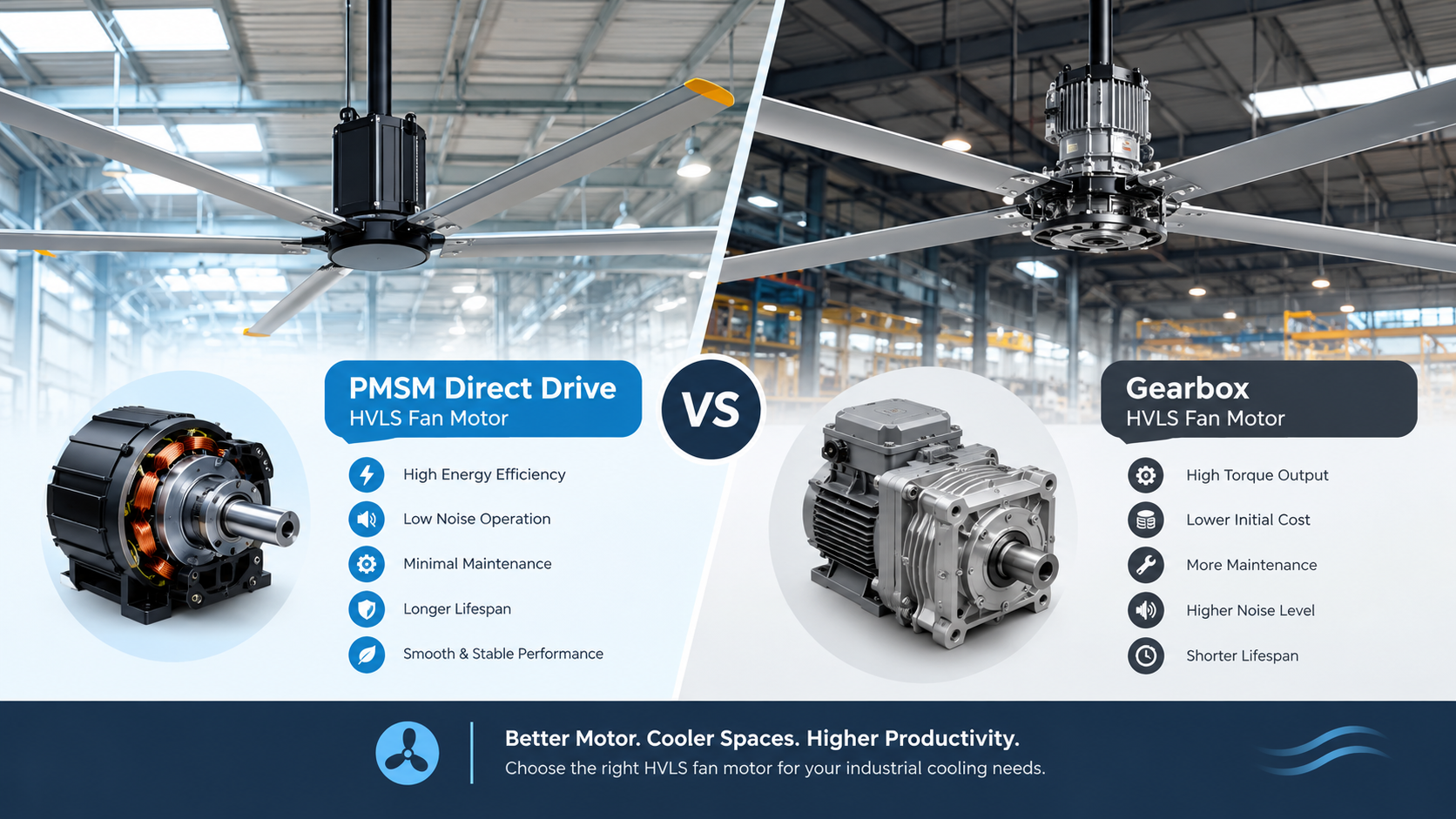
The most important technical consideration when investing in High Volume Low Speed (HVLS) fans for large facilities is choosing the correct motor technology. Choosing between a conventional Gearbox HVLS Fan and a modern PMSM (Permanent Magnet Synchronous Motor) direct drive HVLS ceiling fan will have an impact on your long term running costs, noise levels, energy consumption and life expectancy.
This guide provides a technical breakdown of the options available from your HVLS fan manufacturer to allow facility managers to make the best decision on the drive motor.
1. Understanding the Core Motor Technologies
A. Gearbox Drive HVLS Fans (Traditional)
Traditional high velocity large scale fans used in industry are comprised of an AC Induction Motor which is connected to the blade via a mechanical gearbox.
Operation: The high speed rotation of the motor is slowed down by a series of gears inside the fan to reduce RPMs (between 40-80 RPM).
Maintenance: Regular maintenance is required to change the gear oil and replace seals. Inspection is also required to avoid leakage of oil on the factory floor.
Noise: As there are moving parts there will be some noise generated due to mechanical friction (between 55dB-65dB).
B. PMSM Direct Drive HVLS Fans (Modern)
PMSM motors use permanent magnets to provide ultra high torque. As there are no gear boxes these rare earth magnets are directly attached to the fan blades.
Operation: Electromagnetic direct drive provides smooth variable speed control (VFD). There are no points of friction.
Maintenance: This fan has zero maintenance as there is no gear box or gear oil.
Noise: These fan operate very quietly (under 38-42dB) making them ideal for use in commercial and warehouse environments.
2. Head-to-Head Comparison: PMSM Direct Drive vs. Gearbox Drive
Technical Parameter | PMSM Direct-Drive HVLS Fan | Traditional Gearbox HVLS Fan |
|---|---|---|
Motor Efficiency | High (up to 95% efficiency) | Moderate (80% – 85% efficiency due to gear friction) |
Maintenance Need | Zero gear oil / Maintenance-Free | Periodic oil change & gear replacement |
Noise Output | Ultra-Quiet (< 40 dB) | Moderate Gear Noise (55 dB – 65 dB) |
Weight & Compactness | Lightweight & Compact | Heavy motor assembly |
Operational Lifespan | 10+ Years (Minimal mechanical wear) | 5 to 7 Years (Requires gear servicing) |
Initial Investment | Slightly Higher | Standard |
3. Total Cost of Ownership Impact & HVLS Fan Cost
While the initial cost of a gearless PMSM unit may be 10-15% more than a traditional geared unit, the savings can be seen in the cost of using a direct drive system over 3-5 years.
Lower Energy Costs: PMSM motors use 20-30% less energy than a conventional unit to produce the same volume of air (CFM)
No servicing costs: You don’t have to pay for staff to replace oil, oil costs or seals.
No risk of oil spillage: In food processing environments, pharmaceutical stores and cleanrooms there is no risk of gear oil spilling onto stock or food grade production lines.
4. How to Choose for Your Facility
Select PMSM Direct Drive Fans For Food & Beverage processing units, Pharma warehouses, Auditoriums, Commercial spaces or any applications where ultra quiet, low maintenance is a requirement.
Select Heavy Duty Gearbox Fans For Cost-effective CAPEX solutions for Heavy Fabrication yards, Steel foundries or tough outdoor shed environments with high dust levels.
Sourcing Industrial HVLS Fans for Your Plant
For Industrial Buyers & Facility Engineers: Looking to upgrade your plant ventilation with gearless PMSM technology? Connect directly with top-rated HVLS Fan Manufacturers & Suppliers on Mayo World to request custom quotes and technical catalogs.